Guard the Grill
On Father's Day, the grandfather, and why tradition is something you build before you feel it

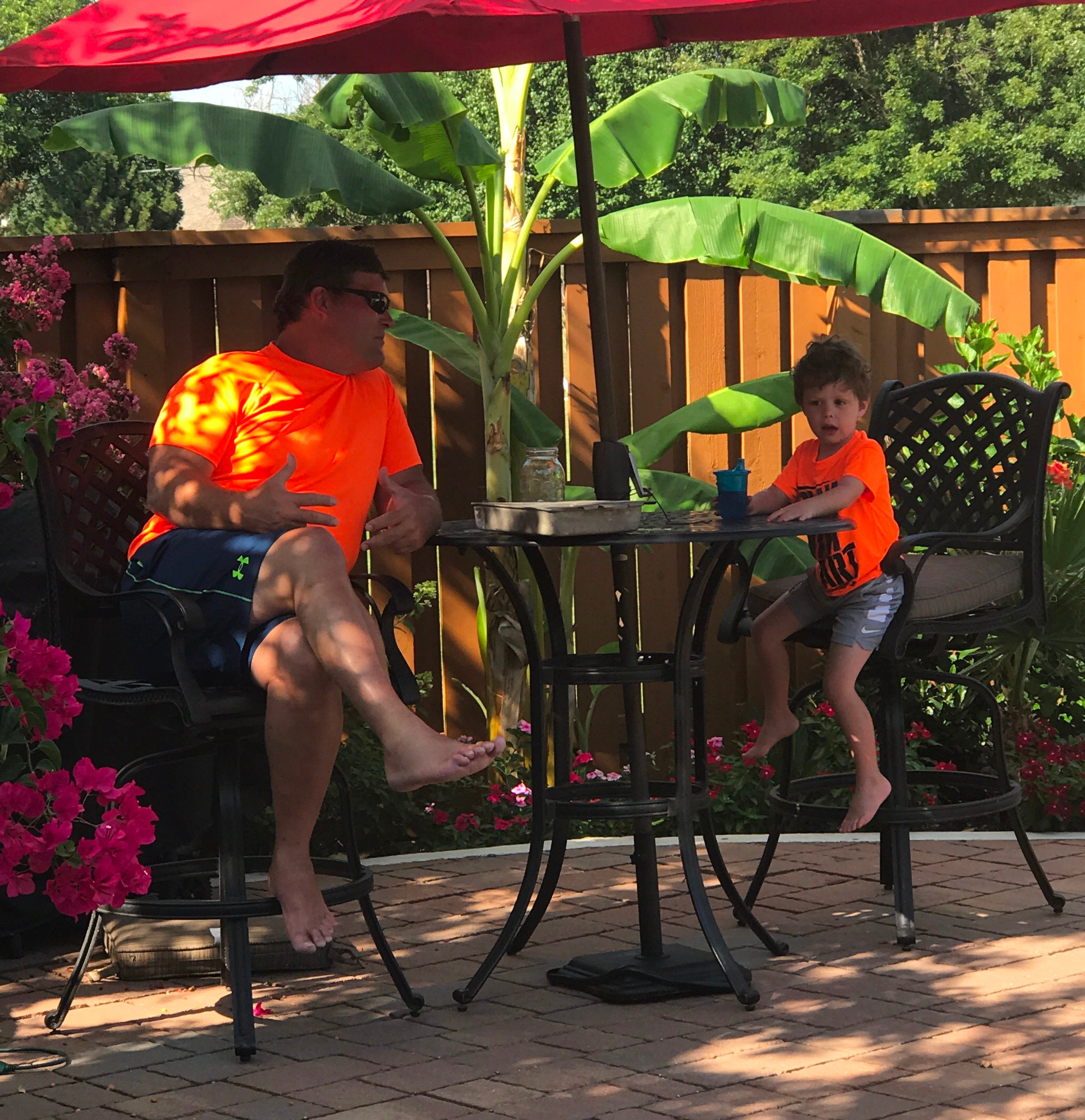
This past Sunday was Father’s Day, and for most of the afternoon I wasn’t the father. I was the son.
I watched my dad out by the grill with my boys. He had burgers on the grill and my boys were sitting beside him, waiting on a story they had already heard before and wanted to hear again. The smell of the charcoal filled the late June air, and I stood off to the side long enough to notice that I was looking at three generations at once. My father, who is a grandfather now. My sons, who will be fathers someday. And me in the middle, holding a plate, not yet old enough to be the storyteller and not young enough to be one of the boys at his knee.
When I got home, I could not help but think about that middle spot.
The easy thing to say about Father’s Day is that fatherhood is about being a provider and giving your time and presence. Show up, pay the bills, and coach the team. But standing by that grill I realized fatherhood changes shape depending on where you stand in line. To my boys I am the father. To my dad I am still the son. And to grandchildren I haven’t met yet, I am the grandfather in training, whether I’ve thought about the job or not.
That last role is the one we almost never talk about, but an important one to reflect on. At least, it has been for me.
The custodian of tradition
When I was young we had real traditions, and they weren’t accidents. We played cards as a family at Thanksgiving. Every year right before Christmas, my grandparents would sit down at the hearth and give a kind of state of the union for the whole family, a reckoning of the year behind us and the wisdom they thought we’d need for the year ahead. On vacation, my mom and dad still build a scavenger hunt for the grandkids. These things felt like they had always existed, but the reality is, someone had to make them. And then someone guarded them.
That is the grandfather’s real job. Not just to be soft and generous with the grandkids, though he gets to be that too. His job is to be the custodian of tradition. He has a strange and beautiful position in the family, fatherly to the grandchildren and playful with his own grown children at the same time, and from that spot he can create the occasions where what matters gets handed down. He keeps a welcoming home. He keeps food and drink on the table, because hospitality has always run on those. And he builds the moments, ideally without a screen anywhere in the room.
I think of Nestor when I sit at that grill. He’s one of my favorite characters in The Iliad, the old man left over from a former age of great fighters, and his gift by the end isn’t his sword. It’s his memory, wisdom, and a little sarcasm. He’s the one who carries the stories of the men who came before. My dad is not Nestor, and our backyard is not Troy, but I understand the old man’s role a lot better now than I did the first time I read it. Every family needs someone like that, someone who holds the lore and tells it well, and we are short on them right now.
The hollow generation
Here is what I’m afraid of.
If our family time is just everyone in the same room staring at separate screens, then there is no substance to pass down. A lot of pixels and not a lot of love. And if my generation doesn’t build real traditions worth inheriting, we’ll be the ones the next generation looks back on as hollow, the inauthentic generation that had every tool to connect and somehow handed down nothing.
Think about how this already plays out with money. How many people inherit what their parents spent an entire lifetime saving, and then blow through it in five years? Five years of spending against a lifetime of saving. The reason it goes so fast is not necessarily the math, it’s that nobody ever told them where it came from. They didn’t know the struggle behind it, didn’t know what it cost or what it was for, so it was easy to treat as nothing.
Wisdom can work the same way. If you don’t know who your family is, where they came from, what their struggles were, and what mattered most to them, then everything they built quietly loses its weight. You can squander a hundred years of hard-won understanding inside a single distracted decade, and you won’t even feel it leave. I don’t want to do that to what my father has given me. I don’t want my sons doing it to what I give them. I’d rather hold the inheritance, grow it, and hand down something larger than I received.
But none of that transfers on its own. You have to create the atmosphere for it. And then guard it closely.
You build the fire before you need it
This is the same thing I’ve been circling in everything I write. Structure beats willpower. You don’t summon a tradition by feeling sentimental about your family on a holiday. You build the conditions and let the meaning show up inside them. Truly a “if you build it, they will come” scenario.
So you make time around the dinner table where stories get told. You play cards or pull out the board game. You light the fire pit and roast the marshmallows because there’s something about being out under the open sky that opens people up. You go to the baseball game or take the trail on the bikes - even if it’s not the easiest thing to do. None of these are complicated, and that’s the point. The tradition isn’t the activity. The activity is just the room you build so the handing-down can happen.
I’ve watched my own boys ask my dad what it was like when he was a kid, over and over, and it surprises me every time how hungry they are for it. The world I grew up in already looks distant to them. That is a strange feeling, because I remember sitting with my dad years ago and feeling the same distance bewteen his childhood and mine. The jump from my parents’ childhood to mine was wide, and the jump from mine to my sons’ is even wider, and theirs to their kids’ will be wider yet. The faster the surface of life changes, the more they need somebody anchoring them to what doesn’t.
My boys can ask AI almost anythingnow and get a clean, correct answer in seconds. I run a marketing company and I use these tools every day, it’s remarkable. But there is a whole category of knowledge that no model will ever hand you, the kind you only get through experience, through memory, through sitting next to someone who loves you while they tell you the truth about where you come from. That knowledge moves at the speed of relationship, and relationship is slow on purpose.
The grill is still going
The men in their fifties right now are becoming grandfathers. My dad already has 14 grandchildren. They are stepping into the custodian’s role whether they’ve named it or not, and the families that thrive over the next thirty years will be the ones where somebody decided to guard the traditions instead of letting them quietly disappear.
I won’t be the grandfather at the grill for a while. For now I’m the man in the middle, holding the plate, watching how my father does it so I’ll know how when it’s my turn. That’s its own kind of fatherhood, the part that’s really about preparing to be the keeper of the flame later.
So light the grill. Tell the stories. Make the traditions, and then guard them like the inheritance they are. Because someday the kids leaning into you at the grill will be holding their own plates, off to the side, watching to see if there’s anything worth keeping.
Make sure there is.
Sent to my Dad. Thanks for the read